Dri-Eaz Water Damage Restoration in Paradise: A Homeowner’s Guide
Dri-Eaz is not a service you hire. It’s the brand of commercial drying equipment that separates a real restoration company from a guy with box-store fans. In Paradise, where the desert air fools homeowners into thinking things dry fast, knowing what Dri-Eaz gear does gives you the power to spot an under-equipped crew before they set foot in your house. If you’re dealing with water damage right now and want to skip the education, call (844) 716-1094 and we’ll walk you through it. Otherwise, here’s what you need to know.
Key Takeaways
- Dri-Eaz LGR dehumidifiers pull moisture in conditions where rental units quit working.
- Equipment capacity is calculated per cubic foot, not per room, and under-equipping is common.
- Air mover count matters as much as dehumidifier size. Professional crews use a 1:1 ratio of air movers to affected rooms at minimum.
- Thermal imaging finds moisture inside walls that visual checks and basic meters miss.
- Asking for an equipment manifest before signing is the single best way to vet a crew.
The Desert Paradox: Why Paradise Homes Stay Wet Longer Than You Think
Everyone assumes a house in Paradise dries fast because the air is dry. That assumption costs homeowners thousands every year. Here’s the problem: surface materials like drywall and baseboards dry quickly in low humidity. That fools basic moisture meters and homeowner eyes into thinking the job is done. But inside wall cavities, under subfloor, and behind cabinetry, the moisture sits. And that trapped moisture is where mold takes hold in as little as 24 to 48 hours, even in Nevada.
This is exactly where low grain refrigerant (LGR) technology matters. A standard refrigerant dehumidifier, the kind you rent at a hardware store, works well when the air is warm and relatively humid. It pulls moisture out of the air efficiently above 60°F and about 50% relative humidity. But once surface conditions improve, that rental unit’s performance drops sharply. The air in the wall cavity is cooler and still damp, but the dehumidifier thinks the room is done. An LGR dehumidifier like the Dri-Eaz 7000XLi keeps pulling moisture in cooler, drier conditions. We often see the gap between an LGR unit and a rental unit exceed 50% moisture removal per day in the same space once surface drying finishes. In a Paradise home where the homeowner thinks everything is dry after two days, that gap decides whether mold gets established. When damage strikes, Valiant answers with the right equipment for the full dry.
What LGR Actually Does: A Non-Engineer’s Explanation
Most dehumidifiers work like a cold glass of lemonade on a summer day. Air hits a cold coil, condensation forms, water drips into a tray. That’s a standard refrigerant dehumidifier. It’s fine for a damp basement in Ohio. It’s not fine for structural drying after a water loss, because structural drying means pulling moisture out of materials that air movement alone can’t reach.
LGR stands for Low Grain Refrigerant. The “grain” refers to grains of moisture per pound of air. LGR dehumidifiers cool their coils more precisely, which lets them keep extracting water vapor at lower temperatures and lower humidity levels. The Dri-Eaz LGR 7000XLi, for example, removes up to 132 pints of water per day at AHAM standard conditions. But the spec that matters in Paradise is that it continues extracting at useful rates when temperatures drop below 60°F, where most rental units fall off a cliff. In a desert climate with big overnight temperature swings, an unheated garage or a slab-on-grade room can drop below that threshold at night. If your crew has standard refrigerant units, the dry stalls every night. If they have LGR units, the dry continues around the clock. That’s the difference between a three-day dry and a seven-day dry. And every extra day is extra money, extra disruption, and extra risk.
How Equipment Capacity Is Calculated: The Math Most Crews Skip
Professional restoration is not “put a dehumidifier in the room and wait.” It’s math. Here’s how we calculate it at Valiant Water Damage home, and it’s a formula any Paradise homeowner can ask their restoration company to show them.
We calculate the cubic footage of the affected space. Not square footage. A 10-by-12 room with 8-foot ceilings is 960 cubic feet. A standard 70-pint rental dehumidifier is rated for roughly 10,000 to 12,000 cubic feet under ideal conditions. That sounds like plenty for that one room. But that “ideal condition” rating assumes 80°F and 60% relative humidity. As conditions improve and the room dries, actual performance drops. That’s why professional water damage restoration in Paradise uses a different standard: we target a minimum of one LGR dehumidifier per 10,000 cubic feet of affected space when the room is saturated, and often more than that based on the number of wet materials and the presence of flooring or wall cavities. A Water Damage Restoration in Paradise estimate should include this calculation on paper. If the company can’t show you the math or gets defensive when you ask, walk away.
Under-equipped looks like this on paper: one LGR unit assigned to a 3,000-square-foot home where two rooms, a hallway, and an adjoining closet are saturated. That’s a crew treating your home like a rental, not a structural drying project. If you’re calling multiple companies, ask each one to list their intended equipment: number of dehumidifiers, number of air movers, and whether thermal imaging will be used. Put it in writing. The estimates that look light on equipment are the ones where the job drags on and the bill climbs.
Air Movers: The Other Half of the Equation
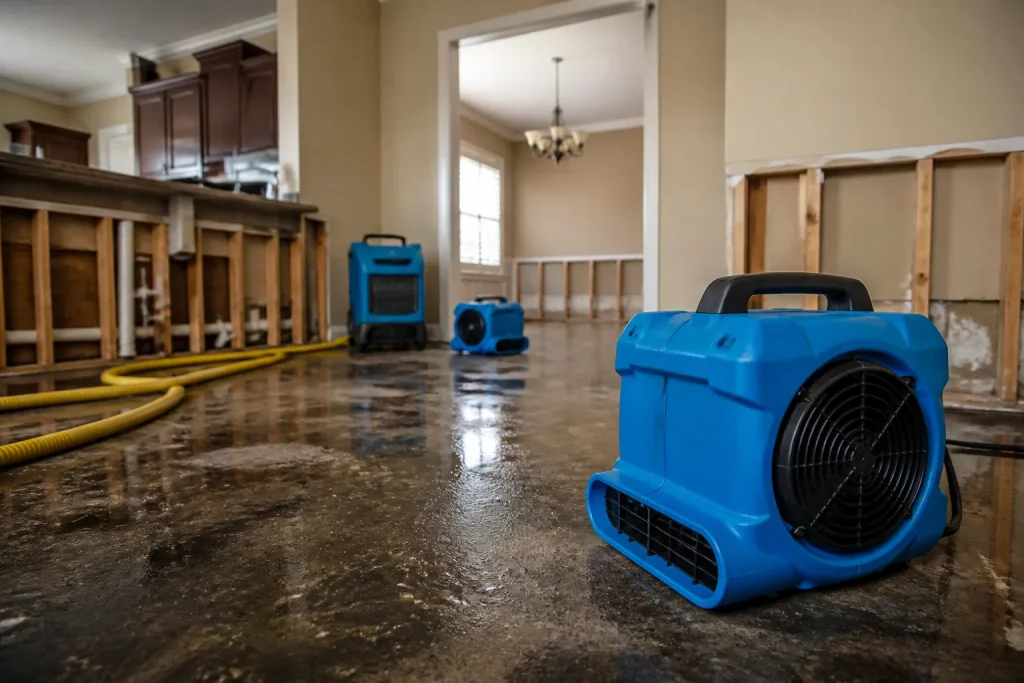
Dehumidifiers pull water from the air. Air movers push the air across wet surfaces to move moisture from the material into the air. Without enough air movers, the dehumidifier has nothing to collect. The professional ratio we use is one air mover per 50 to 75 square feet of affected flooring, and at least one air mover per affected room regardless of size. A standard 3-foot axial air mover moves about 2,800 CFM (cubic feet per minute) on high. In a saturated carpet and pad scenario, that air movement is what makes the water release.
We pulled a job in the Whitney Ranch area last year where a water heater failed in a garage with direct access to a finished hallway. The homeowner called us after another company had been there for four days. The other crew had placed one dehumidifier and two air movers for a 900-square-foot affected area. The baseboards were still swollen and the moisture readings behind the drywall were still above 25%. Our team deployed the correct ratio: four air movers and an additional dehumidifier, and the space was dry in two days. The first company wasn’t malicious. They were under-equipped for a real structural dry. Equipment literacy is the difference between accepting that and pushing back.
Thermal Imaging: The Tool That Finds What Meters Miss
Moisture meters tell you moisture is present when you touch the right spot. Thermal imaging cameras show you where to look. Dri-Eaz makes thermal imaging cameras designed for restoration work, and we include them on every water loss in Paradise. The camera reads temperature differentials across surfaces. Water evaporating behind a wall cools the surface. The camera sees that cooling pattern and maps the true perimeter of the damage. Without thermal imaging, a technician might probe a wall with a pin meter every 12 to 18 inches and still miss a channel of moisture running along a baseplate. With thermal imaging, the full extent of the intrusion shows up before a single cut is made.
This matters for two reasons. First, it prevents unnecessary demolition. If the thermal scan shows the moisture stopped two feet below the window, we don’t cut the whole wall. Precision drying, less demolition. Second, it creates documentation for insurance. The thermal images show the adjuster exactly what was wet and what wasn’t. That’s the kind of evidence that makes a claim move faster. Since we’re IICRC-certified and affiliated with RIA and IFA, we approach every job with the documentation a skeptical adjuster needs to see. If the company you’re vetting doesn’t mention thermal imaging as part of their standard water loss protocol, ask why not.
How to Vet a Crew Using Equipment Literacy
You don’t need to become a restoration tech to protect yourself. You need to ask three questions, and you need to ask them before you sign anything.
- What dehumidifiers are you using, specifically? Look for LGR dehumidifiers from Dri-Eaz or Phoenix. If the answer is “commercial dehumidifiers” without a brand or model, that’s a red flag. The brand is the spec.
- How many air movers will be placed in each room? The answer should be at least one per room, with more for saturated areas. If the math doesn’t start coming out of their mouth, they’re guessing.
- Will you show me your equipment manifest before you start? A professional company has this document ready. It lists every piece of equipment going into your home, where it goes, and how long it stays. A company that won’t show you this is a company that plans to under-deliver.
Also ask about Injectidry capability if the water touched walls or floors with cavities. Injectidry systems push dry air into enclosed spaces: wall cavities, under hardwood floors, beneath cabinets. Most basic crews skip this step and either wait too long or start cutting. If a Paradise home has water staining on a ceiling or along a baseboard, Injectidry often dries the cavity without opening it. That’s a massive difference in repair cost and disruption. Precision drying, less demolition.
The Bottom Line
Dri-Eaz equipment signals a company’s standard. When we roll up to a water damage job in Paradise, we bring LGR dehumidifiers, a calculated air mover count, thermal imaging, and Injectidry capability for cavity drying. Professional-grade equipment, not box-store rentals. That’s not marketing. That’s the mechanical reality of drying a structure correctly. If you’re facing water damage in Paradise and want a crew that does the math, documents everything for your adjuster, and treats your home like a structural drying project rather than a fan rental, call (844) 716-1094 for a free estimate. One call covers water, mold, and fire. If the water issue has been sitting and you suspect mold, see our Mold Remediation in Paradise page. If the damage came from a fire or smoke event combined with water from firefighting, our Fire Damage Restoration in Paradise page covers that process.
Frequently Asked Questions
Dri-Eaz is a brand of professional-grade drying equipment, primarily LGR dehumidifiers and air movers, built for structural drying after water damage. It matters in Paradise because the desert climate creates false dry conditions on surfaces while trapped moisture remains inside walls and floors. LGR dehumidifiers continue extracting moisture at lower temperatures and humidity levels where standard rental units stop working, which shortens dry times and reduces mold risk. Look for this equipment when vetting a restoration company.
A professional calculation is based on the cubic footage of the affected space and the saturation level of materials. We deploy at minimum one LGR dehumidifier per 10,000 cubic feet of affected space, adjusted upward based on wall cavities, flooring, and insulation. An under-equipped job looks like one dehumidifier covering a large home with multiple wet rooms. Ask to see the equipment manifest before you sign, and call (844) 716-1094 if you want a proper calculation.
In most cases, yes, if the water damage resulted from a covered peril like a burst pipe, water heater failure, or storm intrusion. Gradual leaks and lack of maintenance may not be covered. Our team provides photo documentation, thermal imaging records, and moisture mapping to give your adjuster the evidence they need. We also coordinate directly with adjusters so you’re not the one translating restoration technical details into claim language. If you’re unsure about your policy, call us and we’ll help you understand the process.
We treat water damage as an emergency because mold growth can begin within 24 to 48 hours. Call (844) 716-1094 immediately and we’ll assess the situation, walk you through what to do right away, and schedule the right equipment deployment. The sooner extraction and drying start, the less demolition and the lower the final cost.
Written by the team at Valiant Water Damage, serving Paradise since 2016.
Need Damage Restoration Help?
Call Valiant Water Damage — licensed & insured, here with fast after-hours help in Paradise.
(844) 716-1094